
Platform
How Cardvoy works
Why cards need a custody system, and the five steps Cardvoy takes from the ATM to the customer.
The problem
Cards are physical. Most banks still track them on paper.
An ATM keeps a card. A branch gets a list from the switch the next morning, if the file arrives. The card sits in a drawer, the customer calls the helpline, a courier loses a consignment and nobody knows whose desk it was on. Regulators set working-day deadlines and destruction rules, and the bank proves them with registers kept in spreadsheets.
Deadlines missed quietly
Retention periods run in working days across weekends and holidays that differ by country. Nobody sees a card going overdue until a complaint arrives.
Handover by trust
Cards are handed over on a signature in a register. The ID is not checked against the bank's records, and nobody can prove later who took the card.
Couriers as a black box
Consignments, tracking numbers and invoices live in e-mails and spreadsheets. PIN mailers travel with cards, and overcharges are paid because nobody can check them.
How it works
Capture, route, hold, hand over, prove.
- Capture every card the minute an ATM keeps it, from the switch API, a file or a manual entry, with duplicates and unknown terminals stopped.
- Route each card by explainable rules to the branch, the card centre, the issuer or destruction, with a working-day deadline on the country calendar.
- Hold it under dual custody, with physical receipt confirmed and every move recorded.
- Hand over only to the right person: a one-time code to the registered mobile, the ID matched to the customer record and a signature on screen.
- Prove every step to auditors and the regulator from a hash-chained audit trail and ready-made registers.
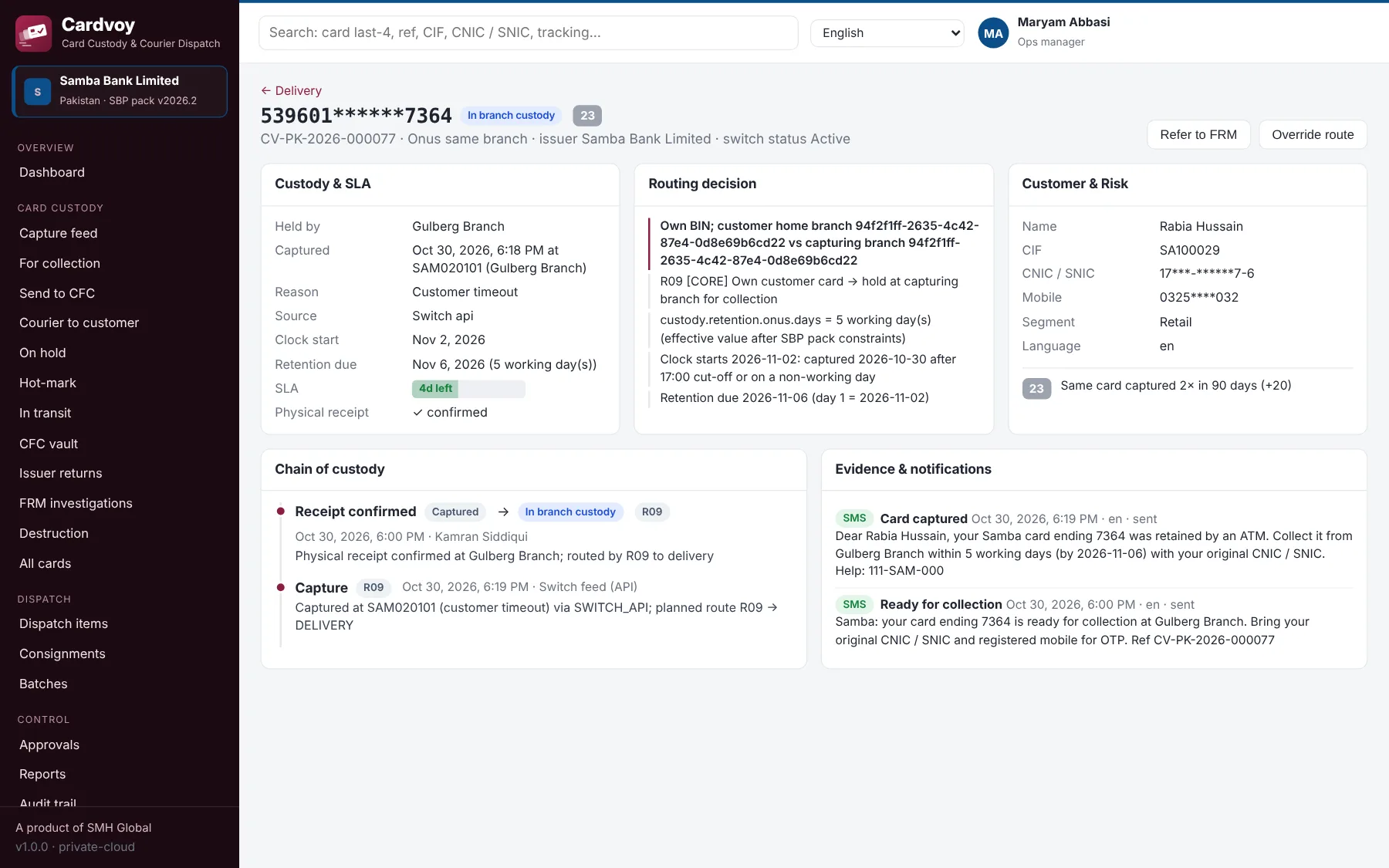
See Cardvoy with your own process.
Book a walkthrough: we set up your branches, card centre, couriers and country pack in a private proof of concept and follow a captured card from the ATM to the customer.